

What Does Camera Obscura Mean
A dwelling house-made pinhole camera lens
A pinhole camera is a simple camera without a lens merely with a tiny aperture (the so-called pinhole)—finer a light-proof box with a small pigsty in 1 side. Low-cal from a scene passes through the aperture and projects an inverted image on the opposite side of the box, which is known every bit the camera obscura effect. The size of the images depends on the distance betwixt the object and the pinhole.
History [edit]
Camera obscura [edit]
The camera obscura or pinhole prototype is a natural optical phenomenon. Early known descriptions are found in the Chinese Mozi writings (circa 500 BCE)[1] and the Aristotelian Problems (circa 300 BCE – 600 CE).[2]

A diagram depicting Ibn al-Haytham'south observations of light's behaviour through a pinhole
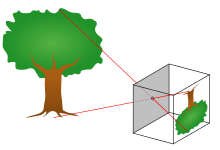
Early pinhole camera. Light enters a nighttime box through a modest pigsty and creates an inverted image on the wall opposite the hole.[three]
Ibn al-Haytham (965–1039), an Arab physicist also known as Alhazen, described the camera obscura effect. Over the centuries others started to experiment with it, mainly in dark rooms with a small-scale opening in shutters, more often than not to study the nature of calorie-free and to safely watch solar eclipses.[4]
Giambattista Della Porta wrote in 1558 in his Magia Naturalis about using a concave mirror to project the image onto paper and to utilise this equally a drawing aid.[v] However, at about the same time, the use of a lens instead of a pinhole was introduced. In the 17th century, the camera obscura with a lens became a pop drawing assist that was further developed into a mobile device, kickoff in a little tent and later in a box. The photographic camera, as developed early in the 19th century, was basically an adaptation of the box-blazon photographic camera obscura with a lens.
The term "pin-hole" in the context of eyes was found in James Ferguson'due south 1764 volume Lectures on select subjects in mechanics, hydrostatics, pneumatics, and optics.[half-dozen] [vii]
Early pinhole photography [edit]
The first known description of pinhole photography is found in the 1856 volume The Stereoscope by Scottish inventor David Brewster, including the clarification of the idea as "a camera without lenses, and with only a pin-pigsty".
Sir William Crookes and William de Wiveleslie Abney were other early photographers to try the pinhole technique.[eight]
Motion picture and integral photography experiments [edit]
According to inventor William Kennedy Dickson, the showtime experiments directed at moving pictures by Thomas Edison and his researchers took place around 1887 and involved "microscopic pin-point photographs, placed on a cylindrical shell". The size of the cylinder corresponded with their phonograph cylinder as they wanted to combine the moving images with sound recordings. Issues arose in recording clear pictures "with phenomenal speed" and the "coarseness" of the photographic emulsion when the pictures were enlarged. The microscopic pivot-point photographs were shortly abased.[ix] In 1893 the Kinetoscope was finally introduced with moving pictures on celluloid motion picture strips. The camera that recorded the images, dubbed Kinetograph, was fitted with a lens.
Eugène Estanave experimented with integral photography, exhibiting a result in 1925 and publishing his findings in La Nature. Later 1930 he chose to continue his experiments with pinholes replacing the lenticular screen.[x]
Usage [edit]
The prototype of a pinhole camera may be projected onto a translucent screen for a real-time viewing (used for safety observation of solar eclipses) or to trace the image on paper. But information technology is more often used without a translucent screen for pinhole photography with photographic motion picture or photographic paper placed on the surface opposite to the pinhole discontinuity.
A common use of pinhole photography is to capture the movement of the sun over a long flow of time. This type of photography is called solarigraphy. Pinhole photography is used for artistic reasons, merely as well for educational purposes to allow pupils larn about, and experiment with, the basics of photography.
Pinhole cameras with CCDs (accuse-coupled devices) are sometimes used for surveillance because they are hard to find.
Related cameras, epitome forming devices, or developments from it include Franke's widefield pinhole photographic camera, the pinspeck camera, and the pinhead mirror.
Mod manufacturing has enabled the production of loftier quality pinhole lenses[xi] that can be applied to digital cameras; allowing photographers and videographers to achieve the photographic camera obscura outcome.
Characteristics of pinhole camera photography [edit]
- As pinhole photographs have about infinite depth of field, everything appears in focus.
- Every bit in that location's no lens distortion, broad-angle images remain absolutely rectilinear.
- Exposure times are usually long, resulting in motion blur around moving objects and the absence of objects that moved too fast.
Other special features can be congenital into pinhole cameras such every bit the ability to take double images by using multiple pinholes, or the power to take pictures in cylindrical or spherical perspective past curving the film plane.
Construction [edit]

A home-made pinhole photographic camera (on the left), wrapped in blackness plastic to forestall light leaks, and related developing supplies
Pinhole cameras can be handmade past the photographer for a particular purpose. In its simplest course, the photographic pinhole camera can consist of a low-cal-tight box with a pinhole in one stop, and a piece of film or photographic paper wedged or taped into the other finish. A flap of cardboard with a tape hinge can be used as a shutter. The pinhole may exist punched or drilled using a sewing needle or small bore bit through a slice of tinfoil or thin aluminum or brass sheet. This piece is and then taped to the inside of the lite-tight box behind a hole cut through the box. A cylindrical oatmeal container may be fabricated into a pinhole camera.
The interior of an constructive pinhole camera is blackness to avoid any reflection of the entering low-cal onto the photographic material or viewing screen.[12]
Pinhole cameras tin exist synthetic with a sliding film holder or dorsum so the distance between the movie and the pinhole tin be adapted. This allows the bending of view of the photographic camera to be changed and also the effective f-finish ratio of the camera. Moving the motion-picture show closer to the pinhole will effect in a broad angle field of view and shorter exposure time. Moving the moving-picture show farther away from the pinhole volition result in a telephoto or narrow-angle view and longer exposure time.
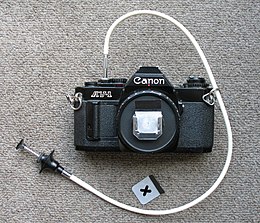
Pinhole cameras tin too be constructed by replacing the lens associates in a conventional camera with a pinhole. In particular, compact 35 mm cameras whose lens and focusing associates accept been damaged can be reused equally pinhole cameras—maintaining the use of the shutter and film winding mechanisms. As a upshot of the enormous increase in f-number, while maintaining the same exposure time, one must use a fast film in direct sunshine.
Pinholes (homemade or commercial) can be used in identify of the lens on an SLR. Use with a digital SLR allows metering and composition past trial and mistake, and is effectively free, and so is a popular way to try pinhole photography.[13]
Option of pinhole size [edit]
Up to a certain point, the smaller the pigsty, the sharper the image, only the dimmer the projected epitome. Optimally, the size of the aperture should be i/100 or less of the altitude between information technology and the projected image.
Within limits, a small pinhole through a thin surface will outcome in a sharper image resolution because the projected circumvolve of confusion at the image plane is practically the aforementioned size equally the pinhole. An extremely small hole, however, can produce meaning diffraction effects and a less clear image due to the wave properties of calorie-free.[14] Additionally, vignetting occurs as the diameter of the pigsty approaches the thickness of the material in which it is punched, because the sides of the hole obstruct the light inbound at anything other than ninety degrees.
The best pinhole is perfectly circular (since irregularities cause higher-guild diffraction effects) and in an extremely thin slice of material. Industrially produced pinholes benefit from laser etching, merely a hobbyist can still produce pinholes of sufficiently high quality for photographic work.
A method of calculating the optimal pinhole diameter was commencement published by Joseph Petzval in 1857. The smallest possible diameter of the paradigm indicate and therefore the highest possible paradigm resolution and the sharpest image are given when:[15]

(Where d is the pinhole diameter, f is the altitude from pinhole to paradigm plane or "focal length" and λ is the wavelength of light.)
The first to apply moving ridge theory to the trouble was Lord Rayleigh in 1891. But due to some wrong and arbitrary deductions he arrived at:[xvi]

And then his optimal pinhole was approximatively 1/iii bigger than Petzval'south.
The correct optimum can be found with Fraunhofer approximation of the diffraction design behind a circular discontinuity at:

This may be shortened to: (When d and f in Millimeters and λ = 550 nm = 0.00055 mm, respective to yellow-green.)
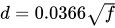
For a pinhole-to-pic distance of ane inch or 25.4 mm, this works out to a pinhole of 0.185 mm (185 microns) in diameter. For f= 50 mm the optimal diameter is 0.259 mm.
The depth of field is basically infinite, but this does not mean that no optical blurring occurs. The infinite depth of field means that prototype blur depends not on object distance but on other factors, such equally the distance from the aperture to the film aeroplane, the aperture size, the wavelength(s) of the light source, and movement of the subject or canvas. Additionally, pinhole photography can not avoid the furnishings of brume.

An example of a 20-minute exposure taken with a pinhole camera

A photograph taken with a pinhole camera using an exposure time of 2s

A graph of the resolution limit of the pinhole camera as a role of focal length (epitome distance).
In the 1970s, Young measured the resolution limit of the pinhole camera as a role of pinhole bore[17] and later published a tutorial in The Physics Teacher.[18] Partly to enable a variety of diameters and focal lengths, he defined two normalized variables: pinhole radius divided by resolution limit, and focal length divided by the quantity south 2/λ, where s is the radius of the pinhole and λ is the wavelength of the light, typically about 550 nm. His results are plotted in the effigy.
On the left-side of the graph, the pinhole is large, and geometric optics applies; the resolution limit is about ane.v times the radius of the pinhole. (Spurious resolution is also seen in the geometric-optics limit.) On the correct-side, the pinhole is pocket-sized, and Fraunhofer diffraction applies; the resolution limit is given by the far-field diffraction formula shown in the graph and now increases equally the pinhole is fabricated smaller. In the region of near-field diffraction (or Fresnel diffraction), the pinhole focuses the light slightly, and the resolution limit is minimized when the focal length f (the distance between the pinhole and the film plane) is given by f = south 2/λ. At this focal length, the pinhole focuses the calorie-free slightly, and the resolution limit is most 2/three of the radius of the pinhole. The pinhole, in this case, is equivalent to a Fresnel zone plate with a single zone. The value s 2/λ is in a sense the natural focal length of the pinhole.
The relation f = south 2/λ yields an optimum pinhole diameter d = 2√ fλ , so the experimental value differs slightly from the gauge of Petzval, above.
Calculating the f-number and required exposure [edit]

A fire hydrant photographed by a pinhole camera made from a shoe box, exposed on photographic paper to create the negative image (top). The positive paradigm (bottom) was created digitally from the negative image. The length of the exposure was 40 seconds. There is noticeable flaring in the lesser-right corner of the image, likely due to inapplicable low-cal entering the photographic camera box.
The f-number of the camera may be calculated by dividing the distance from the pinhole to the imaging plane (the focal length) by the diameter of the pinhole. For case, a camera with a 0.five mm diameter pinhole, and a 50 mm focal length would have an f-number of l/0.5, or 100 (f/100 in conventional notation).
Due to the large f-number of a pinhole photographic camera, exposures will often encounter reciprocity failure.[19] Once exposure fourth dimension has exceeded about 1 second for film or 30 seconds for newspaper, one must compensate for the breakup in linear response of the film/paper to intensity of illumination past using longer exposures.
Exposures projected on to modernistic low-cal-sensitive photographic moving picture tin can typically range from five seconds up to as much as several hours, with smaller pinholes requiring longer exposures to produce the same size paradigm. Because a pinhole camera requires a lengthy exposure, its shutter may exist manually operated, as with a flap fabricated of opaque material to embrace and uncover the pinhole.
Coded apertures [edit]
A non-focusing coded-aperture optical system may be idea of equally multiple pinhole cameras in conjunction. By adding pinholes, calorie-free throughput and thus sensitivity are increased. However, multiple images are formed, usually requiring computer deconvolution.
Mod mean solar day involvement in pinhole photography [edit]
A revival in popularity has get evident in recent years with the success of Kickstarter crowdfunding campaigns offering a range of pinhole photography products. From a camera crafted from wood[20] to the Pinhole Pro[eleven] - a sleek lens designed for DSLR and MILC digital cameras - these projects take drawn investment from thousands of enthusiastic backers to enhance hundreds of thousands of dollars.
Natural pinhole miracle [edit]

A pinhole camera upshot can sometimes occur naturally. Small "pinholes" formed by the gaps between overlapping tree leaves will create replica images of the sun on apartment surfaces. During an eclipse, this produces small crescents in the case of a fractional eclipse, or hollow rings in the case of an annular eclipse.
Observation [edit]
Worldwide Pinhole Photography Day is observed on the terminal Sunday of April, every yr.[21]
Photographers using the technique [edit]
- Billy Childish
- George Davison
- Barbara Ess
- Wolf Howard
- Steven Pippin
- Jesse Richards
See likewise [edit]
- Camera obscura (commonly employs a lens)
- Dirkon
- Henry Fox Talbot
- Ibn al-Haytham
- Nautilus (whose pinhole eye functions every bit a camera obscura)
- Pinhole camera model
- Pinhole glasses
- Pinhole occluder, a similar device used by ophthalmologists
- Spatial filter
- The Great Picture
- Zone plate
References [edit]
- ^ "CS194-26: proj2". inst.eecs.berkeley.edu . Retrieved 2022-01-07 .
- ^ "Camera Obscura: Ancestor of Modern Photography | Encyclopedia.com". www.encyclopedia.com . Retrieved 2022-01-07 .
- ^ Kirkpatrick, Larry D.; Francis, Gregory E. (2007). "Low-cal". Physics: A World View (half-dozen ed.). Belmont, California: Thomson Brooks/Cole. p. 339. ISBN978-0-495-01088-iii.
- ^ Plott, John C. (1984). Global History of Philosophy: The Menstruum of scholasticism (part 1). p. 460. ISBN978-0-89581-678-8.
- ^ Zik, Yaakov; Hon, Giora (x February 2019). "Claudius Ptolemy and Giambattista Della Porta: Two Contrasting Conceptions of Eyes". arXiv:1902.03627 [physics.hist-ph].
- ^ "Nick's pinhole photography". idea.uwosh.edu . Retrieved 29 Jan 2018.
- ^ Ferguson, James (1764). Lectures on select subjects in mechanics, hydrostatics, pneumatics, and eyes with the utilize of the globes, the fine art of dialing, and the adding of the hateful times of new and full moone and eclipses.
- ^ "Pinhole photography history". photo.net. Archived from the original on 2017-02-02. Retrieved 29 January 2018.
- ^ History of the kinetograph, kinetoscope, & kinetophonograph [by] W. Chiliad. L. Dickson and Antonia Dickson. Literature of cinema. Arno Printing. 1970. hdl:2027/mdp.39015002595158. ISBN9780405016110.
- ^ Timby, Kim (31 July 2015). 3D and Blithe Lenticular Photography. ISBN9783110448061.
- ^ a b "Pinhole Pro Lens past Thingyfy". 2018.
- ^ "How to Brand and Use a Pinhole Photographic camera". Archived from the original on 2016-03-05.
- ^ "V3 - digital transformation news, assay and insight". v3.co.britain . Retrieved xviii October 2018.
- ^ Hecht, Eugene (1998). "v.7.half-dozen The Camera". Optics (3rd ed.). ISBN0-201-30425-ii.
- ^ Petzval, Joseph Maximilian (1857), "Bericht über dioptrische Untersuchungen". Vortrag vom 23. Juli 1857; in: Sitzungsberichte der kaiserlichen Akademie der Wissenschaften, mathematisch-naturwissenschaftliche Classe, vol. XXVI, Southward. 33-90
- ^ Lord Rayleigh Sec. R.South. (1891), Ten."On Pin-hole Photography", in: Philosophical Magazine, Series 5, Book 31, 1891 – Upshot 189, pp.87-99
- ^ Young, Yard. (1971). "Pinhole optics". Applied Optics. ten (12): 2763–2767. Bibcode:1971ApOpt..ten.2763Y. doi:10.1364/ao.ten.002763. PMID 20111427.
- ^ Immature, Matt (1989). "The pinhole camera: Imaging without lenses or mirrors". The Physics Teacher. 27 (ix): 648–655. Bibcode:1989PhTea..27..648Y. doi:x.1119/i.2342908.
- ^ breslin, nancy a. "Nancy Breslin's pinhole camera exposure tips". www.nancybreslin.com . Retrieved 29 January 2018.
- ^ "Wooden pinhole camera by ONDU". 2015.
- ^ "Worldwide Pinhole Photography Day". pinholeday.org.
Further reading [edit]
- Eric Renner Pinhole Photography: From Historic Technique to Digital Application [ ISBN missing ]
External links [edit]
 Media related to Pinhole cameras at Wikimedia Eatables
- pinhole.cz
- Pinhole Photography by Vladimir Zivkovic
- Worldwide Pinhole Photography Mean solar day website
- An easy mode to convert a DSLR to a pinhole camera
- Pinhole Photography and Photographic camera Design Calculators
- Illustrated history of cinematography
- Oregon Art Beat: Pinhole Photos by Zeb Andrews
- Civil War 150 Pinhole Project past Michael Falco

Source: https://en.wikipedia.org/wiki/Pinhole_camera
Posted by: inglefroby1954.blogspot.com
0 Response to "What Does Camera Obscura Mean"
Post a Comment